

PF Filing Online in Chennai
Aanoor Global is the best PF consultant in Chennai. EPF (Employee Provident Fund) is one of the significant advantages offered to the employees when they get relieved from a company or provided in a lump at the time of retirement.
PF registration in Chennai helps eligible establishments comply with EPF and related EPFO requirements. Aanoor Global provides support for EPF registration, employer setup, employee PF enrollment, UAN-related compliance, monthly ECR filing, contribution calculation, and ongoing PF compliance.
Whether you're starting a new company, expanding your workforce, or need help with regular PF filing, our team can assist with documentation, portal processes, payroll reconciliation, and compliance tracking.
Based on 350+ trust reviews
Quick Answer - What Is PF Registration?
PF registration is the process through which an eligible establishment registers with EPFO and obtains the necessary employer registration details for administering provident-fund compliance.
Once covered, the employer generally needs to: register the establishment, enroll eligible employees, maintain employee and payroll records, calculate contributions, generate/upload the monthly Electronic Challan-cum-Return (ECR), remit contributions and charges, and maintain UAN and employee records.
A Note on the Current Legal Framework

The four new labour codes — including the Code on Social Security, 2020, which consolidates the EPF & MP Act, 1952 along with several other laws — were brought into force nationwide on 21 November 2025. Central and state-level implementation rules were still being finalized as of early 2026.
This page describes PF/EPF compliance under the framework generally understood at the time of writing. Specific section numbers, contribution rates, penalty structures, and procedures may be updated as the Code on Social Security's rules are finalized. Always verify current requirements against the latest EPFO and Ministry of Labour and Employment notifications before relying on any specific figure in this guide.
Quick Facts About PF Registration
Applicability depends on the establishment, industry, employee strength, and applicable statutory provisions. The threshold should not be treated as a universal rule for every establishment.
What Is PF Registration?

PF registration is the process through which an eligible establishment registers with EPFO and obtains the necessary employer registration details for administering provident-fund compliance.
Once covered, the employer generally needs to: register the establishment, enroll eligible employees, maintain employee and payroll records, calculate contributions, generate/upload the monthly Electronic Challan-cum-Return (ECR), remit contributions and charges, and maintain UAN and employee records.
What Is EPF?
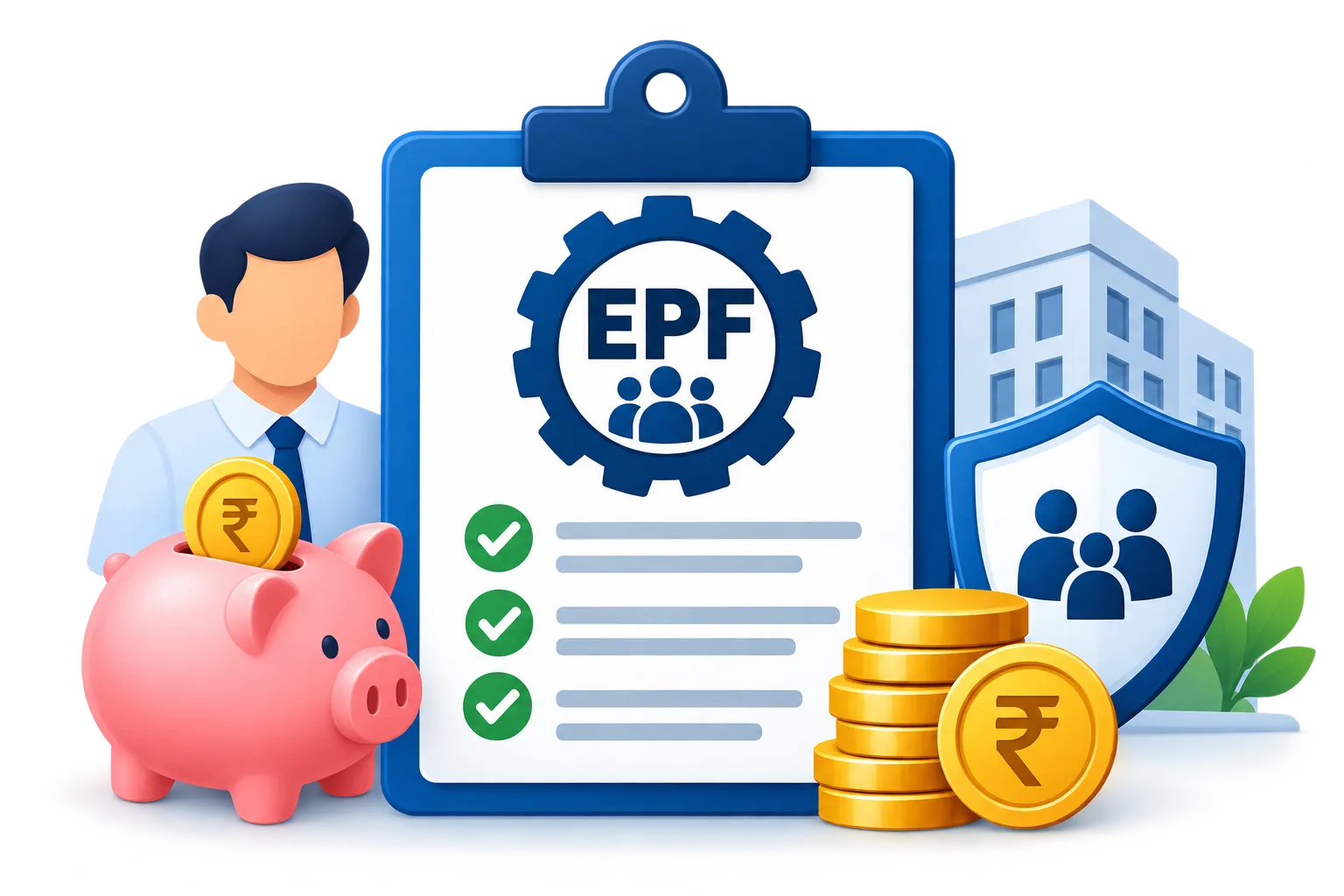
EPF is a statutory social-security savings system administered by EPFO, made up of three components:
EPF
Provident fund savings
EPS
Employees' Pension Scheme
EDLI
Employees' Deposit Linked Insurance Scheme
PF is not simply a payroll deduction — it involves employer registration, employee enrollment, contribution calculation, ECR filing, payment, and ongoing record maintenance.
Who Needs PF Registration?

PF registration may apply to establishments covered under the applicable law and relevant notifications:
Private Limited Companies
Reaching the applicable coverage threshold
LLPs
Depending on employee strength and applicable provisions
Partnership Firms
Employing eligible workers
Proprietorship Firms
Where statutory conditions are met
Factories and other establishments
Falling within notified coverage categories
Contractors
Who can carry additional PF compliance responsibility depending on the arrangement
Is PF Registration Mandatory for 20 Employees?
The commonly referenced threshold is 20 employees for covered establishments. This shouldn't be treated as a universal answer — applicability also depends on the type of establishment, industry, notified coverage, and voluntary coverage arrangements.
PF Registration for New and Private Limited Companies
New businesses often ask whether they should wait until reaching 20 employees before considering PF compliance. The answer depends on the company's actual establishment details.
For a new company, review:
A company shouldn't assume incorporation itself creates PF liability — applicability is a separate statutory question, reviewed against the same factors above regardless of whether it's a new or private limited company.
EPF Registration Process
Registration is completed online through EPFO's employer systems. New businesses may also encounter EPF registration linked through the government's Shram Suvidha portal or MCA's SPICe+ single-window incorporation process, in addition to registering directly. Ongoing monthly compliance (ECR filing) happens through the EPFO Unified Employer Portal.
Determine applicability
Review employee strength, business activity, and applicable provisions.
Prepare employer information
Establishment and employer details required for registration.
Register on the EPFO employer portal
Register on the applicable EPFO employer portal.
Submit establishment information
Submit establishment information.
Complete authentication
Complete required authentication.
Receive registration details
Receive employer registration details.
Configure payroll
Configure payroll for PF contribution calculations.
Register/enroll employees
Ensuring UAN/member information is correctly mapped.
Documents Required for PF Registration
Business documents
Certificate of Incorporation/registration certificate
PAN of the establishment
Address proof
Business constitution details
Bank account information
Authorised signatory details
Employer/authorised person
PAN
Aadhaar or other prescribed ID
Contact details
Digital authentication/signing details where applicable
Employee & payroll information
Employee name
Date of joining and date of birth
Aadhaar details where required
Bank details
Existing UAN (if any)
Basic wage and PF wage details
Documents and portal requirements should be checked against the current EPFO process at the time of application.
PF Contribution: The Complete Breakdown
Contribution treatment can also vary based on employee category, pension eligibility, international-worker status, and exempted-establishment rules — payroll should be configured based on each employee's actual statutory status, not one formula applied uniformly.
What Is PF Filing?
PF filing generally refers to the employer's monthly process of preparing and submitting the ECR and paying applicable contributions and charges:
Step 1
Collect payroll data
Step 2
Check employee UAN details
Step 3
Calculate PF contributions
Step 4
Reconcile employee and employer shares
Step 5
Prepare and submit the ECR
Step 6
Generate the challan
Step 7
Make online payment
Step 8
Retain required records
EPFO describes ECR as an electronic monthly return uploaded by employers through the Unified Portal.
PF Filing Due Date and Late Payment Consequences
Monthly PF contribution and ECR filing should generally be completed on or before the 15th of the following month (e.g., September's salary → ECR and payment by 15 October).
Don't rely on historical extensions or grace periods as normal practice — EPFO may issue specific extensions only in exceptional circumstances such as technical difficulties.
Monthly PF Filing Process
Payroll data collection
The month's salary and attendance/payroll information.
Employee verification
UAN, joining/exit dates, PF eligibility, wage components, contribution status.
PF calculation
Applicable employee and employer contributions.
Payroll reconciliation
Matching payroll deductions against contribution figures.
ECR preparation and upload
Through the EPFO employer portal.
Challan generation
Generate the challan for the month's contributions.
Online payment
Within the statutory timeline.
Record maintenance
ECR, challan, payroll, and supporting records for reconciliation and inspection.
New Employee PF Registration & UAN
When a new eligible employee joins, verify whether they already have a UAN.
Existing UAN
Should be linked/mapped appropriately rather than unnecessarily creating a new identity.
No existing UAN
Follow the applicable generation/allotment process. UAN activation is currently handled through Aadhaar-based face authentication on UMANG.
Ongoing Employee PF Compliance
Monitor:
PF Compliance for Contractors
Businesses using contractors should review PF responsibilities carefully — contractor registration/compliance, employee coverage, UAN details, wage records, ECR information, and contribution reconciliation. Review the actual contract structure rather than assuming responsibility automatically sits with either the contractor or the principal employer.
PF vs. ESI vs. Professional Tax
Businesses can have both PF and ESI obligations where their establishment and employees meet the respective conditions.
Ready to Set Up or Review Your PF Compliance?
Whether you're registering for the first time, adding new employees, or trying to untangle a payroll-to-ECR mismatch before it becomes a bigger problem, getting it reviewed now is cheaper than fixing it after a notice arrives.
Common PF Registration Mistakes
Assuming 20 employees is the only factor
Applicability also depends on establishment type and notified provisions.
Creating duplicate UANs
For employees who already have one.
Incorrect date of joining
Affects records and contribution calculations.
Incorrect wage components
PF calculation should follow applicable statutory wage rules.
Missing the ECR deadline
Late filing/payment carries real interest and damages exposure.
Payroll and ECR mismatch
Deductions should reconcile with what's actually filed.
Ignoring contractor employees
Contract labour arrangements need separate PF review.
Incorrect employee exit dates
Creates downstream problems for the employee.
PF Filing Compliance Checklist
Professional Fees and Timeline
There's generally no separate government registration fee for PF registration itself — it's free through the EPFO portal. Our professional fee for registration, employee enrollment, or monthly filing depends on employee count, establishment structure, payroll complexity, filing volume, contractor workforce, and any historical compliance issues to resolve.
Contact Aanoor Global for the current professional fee applicable to your business.
Registration and filing timelines depend on the completeness of employer information, portal processing, authentication requirements, and any EPFO queries — we don't promise a fixed government approval time, since this varies by portal load and data completeness. For monthly filing, the key deadline is the 15th of the following month, regardless of how long registration itself takes.
Chennai Businesses We Support
Aanoor Global provides PF registration and compliance support for businesses across T. Nagar, Anna Nagar, Nungambakkam, Guindy, Adyar, Mylapore, Velachery, Porur, OMR, Perungudi, Sholinganallur, Ambattur, Tambaram, Chromepet, Mogappair, Vadapalani, Kodambakkam, Kilpauk, Egmore, and Perambur.
Whether you're searching for PF registration near me, EPF registration in Chennai, or PF filing services near me, our team can support both the registration and the recurring compliance workflow.
Illustrative Example
A Chennai-based private limited company grows from 12 to 24 employees. Rather than waiting until payroll becomes difficult to manage, the company reviews its EPF applicability and payroll structure — covering employee count, wage structure, PF applicability, UAN status, payroll configuration, and the monthly ECR workflow.
This is an illustrative example, not a claim about an actual Aanoor Global client.
Why Choose Aanoor Global for PF Registration & Filing?
End-to-end support
From EPF registration through monthly ECR filing.
Payroll-focused approach
Reconciliation before filing, not after.
Employee compliance support
Enrollment, UAN, joining/leaving compliance.
Chennai-based
Supporting businesses across the city and surrounding commercial/industrial areas.
Compliance calendar tracking
To reduce missed monthly deadlines.
Transparent process
We explain what's required, what's being filed, and what depends on EPFO processing versus statutory requirements.
Frequently Asked Questions
Q1 What is PF registration?
The process through which an eligible establishment registers with EPFO for provident-fund compliance.
Q2 Is PF registration mandatory for 20 employees?
20 employees is the commonly referenced coverage threshold, but applicability depends on the establishment and relevant statutory provisions.
Q3 Can a company register for PF with fewer than 20 employees?
Some establishments have coverage or voluntary registration options depending on applicable provisions — the business should be assessed individually.
Q4 What is PF filing?
Preparing and submitting the monthly ECR and remitting applicable contributions and charges.
Q5 What is the PF filing due date?
Generally the 15th of the following month.
Q6 What is ECR?
Electronic Challan-cum-Return — the electronic monthly filing EPFO requires for PF contribution compliance.
Q7 What is UAN?
Universal Account Number — used to identify and manage an employee's EPF membership across employment.
Q8 Can an employee have multiple UANs?
They should generally avoid duplicates; existing UAN information should be correctly handled when an employee changes employers.
Q9 Does PF apply to contract employees?
Contract labour can be subject to PF requirements depending on the employment arrangement and applicable provisions.
Q10 Does PF apply to employees earning more than ₹15,000?
Not automatically excluded — membership and higher-wage contributions are possible through a joint employer-employee request, subject to applicable conditions.
Q11 What happens if PF payment is late?
Late payment can attract interest under Section 7Q and penal damages under Section 14B. The exact damages calculation has changed with recent amendments — verify the current EPFO schedule rather than relying on an older percentage figure.
Related Services
Disclaimer
This page is provided for general information about PF/EPF registration and filing. EPF applicability, contribution treatment, employee coverage, wage calculations, ECR requirements, deadlines, and penalty structures depend on the establishment, employee category, and the applicable laws, schemes, and notifications in force at the relevant time — including the ongoing transition to the Code on Social Security, 2020, which came into force on 21 November 2025 and consolidates the EPF & MP Act, 1952 alongside other labour legislation.
This page does not guarantee EPFO registration, approval, contribution treatment, or resolution of any statutory issue. Employers should verify current EPFO and Ministry of Labour and Employment requirements before filing or relying on any specific figure in this guide.
Registration Help?
Our qualified liaison team is ready to submit your license applications correctly.
Fast Track Liaison
Obtaining registrations shouldn't be stressful. We follow up directly with respective authorities to speed up approvals.