

TAN Registration in Chennai
If your business is responsible for deducting or collecting tax at source, you may need a TAN (Tax Deduction and Collection Account Number). TAN is a unique 10-character alphanumeric number issued by the Income Tax Department and is used to identify persons responsible for deducting or collecting tax at source.
At Aanoor Global, we help businesses in Chennai understand whether TAN is applicable to their transactions, prepare the required information, submit the application and handle related compliance requirements. Whether you operate a private limited company, LLP, partnership, proprietorship or another eligible entity, getting the TAN requirement right at the beginning can help avoid unnecessary compliance issues later.
Need help with TAN registration in Chennai? Get your TAN requirement reviewed and understand the application process before submitting your application.
Based on 350+ trust reviews
Quick Facts About TAN Registration
| Particular | Details |
|---|---|
| Full Form | Tax Deduction and Collection Account Number |
| Issuing Authority | Income Tax Department |
| Format | 10-character alphanumeric number |
| Main Purpose | Identification of tax deductors and collectors |
| Applicable To | Persons responsible for specified TDS/TCS obligations |
| Application Route | Prescribed TAN application process |
| Current Protean Forms | Form 134 for Government applicants and Form 135 for other applicants |
| Application Fee | ₹77 including applicable GST through Protean, subject to current fee |
| Processing Time | Varies depending on processing and verification |
| Status Tracking | Status can generally be checked using the acknowledgement number after the applicable waiting period |
Important: TAN is not automatically required for every transaction involving tax deduction. Certain specified provisions permit PAN-based reporting or have different requirements. The applicable provision should therefore be checked before applying.
Quick Answer: Do You Need TAN Registration?
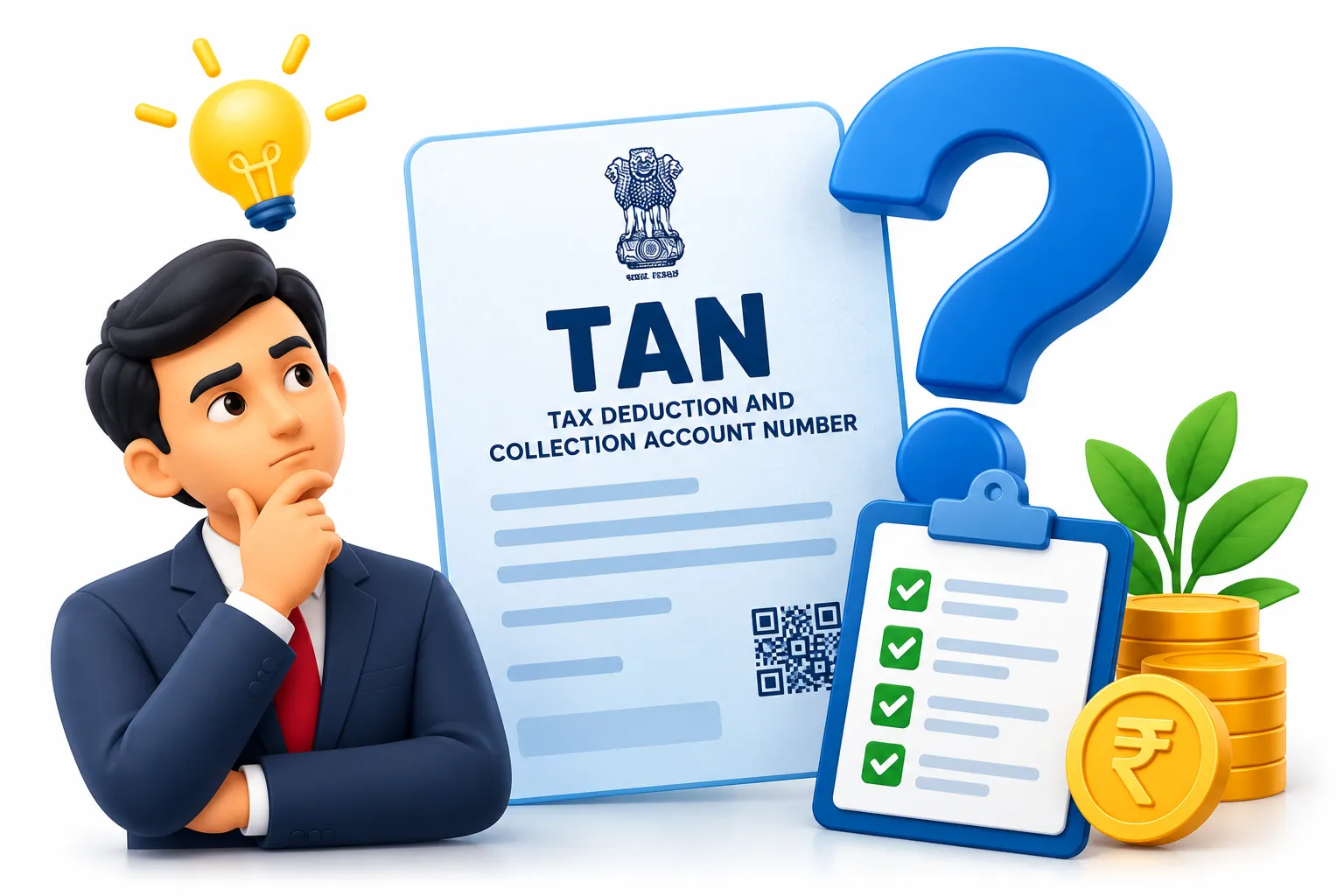
TAN registration is generally required for a person responsible for deducting or collecting tax at source under applicable provisions of the Income Tax Act. However, there are specified situations where TAN may not be required and PAN-based reporting may apply.
For example, certain specified TDS provisions allow reporting using PAN instead of TAN. Therefore, businesses should first identify the nature of the payment and the applicable TDS/TCS provision rather than assuming that every TDS transaction requires a separate TAN.
If you are unsure whether your business needs TAN, Aanoor Global can help review the applicable requirement before you submit an application.
What Is TAN?
TAN stands for Tax Deduction and Collection Account Number. It is a unique 10-character alphanumeric number allotted by the Income Tax Department to persons who are required to deduct or collect tax at source under applicable provisions.
TAN is used in various TDS/TCS-related compliance activities, including reporting and related documentation. It is different from PAN.
PAN vs TAN
Who Needs TAN Registration?

TAN is generally applicable to persons who are responsible for deducting or collecting tax at source under provisions where TAN is prescribed. This may include businesses and organisations making payments such as:
The actual requirement depends on the relevant section, payment type, threshold and nature of the transaction.
Does a Proprietorship Need TAN?

A proprietorship does not automatically need TAN simply because it is a business. The requirement depends on whether the proprietor becomes responsible for deducting or collecting tax under a provision that requires TAN.
For example, if a proprietor has TDS obligations applicable to its business payments, TAN may become necessary. Therefore, the correct approach is to check the actual TDS/TCS obligation, rather than determining the requirement only from the business structure.
When TAN May Not Be Required
TAN is not required in every situation involving tax deduction or collection. Certain specified provisions provide exceptions or permit PAN-based reporting. This means a business should not apply for TAN solely because it has made a payment that appears to involve TDS.
Before applying, check:
If the situation is unclear, professional review can help prevent an unnecessary application or incorrect compliance setup.
Why Is TAN Important?

Having the correct TAN becomes important when your business is subject to applicable TDS/TCS obligations. It may be required for activities such as:
Incorrect TAN details or failure to follow applicable TDS/TCS requirements can create compliance difficulties.
Documents Required for TAN Application
The exact documentation depends on the applicant and application route. Information commonly required includes:
Commonly Required Information
Applicant/deductor name
PAN details
Applicant address
Contact details
Details of the responsible person
Business/entity information, where applicable
Relevant supporting information required by the application
Authorised signatory details, where applicable
Before Submission, Check That:
Name is entered correctly
PAN information is accurate
Address is consistent
Applicant type is selected correctly
Contact information is active
Supporting details are complete
Existing TAN details are checked before applying for another TAN
For companies, LLPs, partnerships and other entities, the information should match the entity's official records.
TAN Registration Process
The TAN application process generally involves the following steps:
Step 1 — Check TAN Applicability
Identify whether the business has a TDS/TCS obligation for which TAN is required.
Step 2 — Collect Information
Prepare the applicant, PAN, address and responsible-person details required for the application.
Step 3 — Select the Applicable Application Route
Use the current prescribed TAN application process applicable to the applicant.
Step 4 — Complete the Application
Enter the applicant and deductor/collector information carefully.
Step 5 — Verify the Details
Review the application before submission to minimise errors.
Step 6 — Submit the Application
Submit through the applicable authorised channel.
Step 7 — Complete Authentication
Where applicable, complete the required authentication, signature or supporting process.
Step 8 — Receive the Acknowledgement
Keep the acknowledgement/reference number safely for future status tracking.
Step 9 — Track the Application
Use the prescribed status-tracking facility to check the progress of the application.
Current TAN Application Forms
Applicants may encounter older online articles referring to Form 49B. The current Protean application framework uses updated forms, including:
Always check the current application form and instructions before submission because application procedures and forms can be updated.
TAN Registration Cost in Chennai
The government/application-side cost should be distinguished from professional assistance charges. Protean currently lists the TAN application processing fee at ₹77 including applicable GST, subject to the current payment structure and applicable updates. If you use professional assistance, the service provider's professional fee will be additional.
Your total cost may therefore include:
Always verify the current application fee before payment.
How Long Does TAN Registration Take?
There is no guaranteed single processing time for every TAN application. Processing can vary depending on:
Indicative expectation: many straightforward applications may be processed within a few working days, but actual TAN allotment can vary. For applications submitted through Protean, status can generally be checked using the 14-digit acknowledgement number after three days, subject to the current tracking instructions. Therefore, businesses should not treat a particular number of days as a guaranteed allotment period. Important: Check your application status rather than assuming TAN will be allotted within a fixed number of working days.
Online TAN Registration
TAN application can be submitted through the prescribed online application facility. An online application generally involves:
Aanoor Global can help review the information before submission so that common application errors can be identified early.
Common TAN Application Mistakes
Some common problems include:
TAN Correction Process
If an allotted TAN contains incorrect or outdated information—such as the deductor/collector name, address, contact details or other particulars—you should use the prescribed TAN correction/change process rather than applying for another TAN.
The correction request should be submitted through the current prescribed route with the supporting information or documents required for the particular correction. Do not apply for a new TAN merely to correct details in an existing TAN.
Aanoor Global can assist with reviewing the existing TAN information, identifying the correction required and preparing the appropriate correction request.
What Happens After TAN Is Allotted?
Obtaining TAN is only one part of TDS/TCS compliance. Depending on your business activities, you may subsequently need to manage:
The exact requirements depend on the nature of your deductions or collections.
TRACES Registration After TAN
TRACES (TDS Reconciliation Analysis and Correction Enabling System) provides facilities relating to TDS/TCS statements, certificates, defaults and related compliance activities.
After TAN allotment, businesses responsible for TDS/TCS should use the applicable Income Tax Department systems for their deductor/collector compliance. Where TRACES registration is applicable to your deductor/collector profile, the registration process requires the relevant TAN and other required information.
Aanoor Global can assist with the applicable registration and subsequent TDS/TCS compliance workflow.
TAN vs TDS Registration
These terms are sometimes used interchangeably, but they are not exactly the same. TAN is the identification number allotted to a person responsible for applicable TDS/TCS obligations. TDS/TCS compliance refers to the wider set of activities that may follow, including payment, statement filing, certificates, reconciliation and correction.
Getting a TAN does not mean that all TDS compliance is automatically completed. Businesses should establish the complete compliance workflow after TAN allotment.
TAN Registration vs TDS Return Filing
Private Limited Company
A private limited company may require TAN when it becomes responsible for applicable TDS/TCS obligations.
LLP
An LLP may require TAN depending on its TDS/TCS responsibilities.
Partnership Firm
A partnership firm may need TAN when the firm has applicable tax deduction or collection obligations.
Proprietorship
A proprietor does not need TAN merely because the business exists. The requirement depends on the applicable TDS/TCS provisions.
Other Organisations
Trusts, societies, companies and other organisations should assess TAN requirements based on their actual tax deduction or collection responsibilities.
Example: TAN Requirement for a Chennai Business
Illustrative Example. Consider a Chennai-based business that makes several types of payments during the financial year. The business should not decide whether TAN is required merely by looking at the payment amount or business structure. Instead, it should review:
Once the applicable requirement is established, the business can proceed with the appropriate TAN application and related compliance. Note: This is an illustrative example and is not a representation of a specific client's results.
TAN Registration Support in Chennai
Aanoor Global provides TAN-related assistance to businesses across Chennai, including areas such as T. Nagar, Anna Nagar, Nungambakkam, Guindy, Adyar, Mylapore, Velachery, Porur, OMR, Perungudi, Sholinganallur, Ambattur, Tambaram, Chromepet, Mogappair, Vadapalani, Kodambakkam, Kilpauk, Egmore and Perambur.
If you are searching for TAN registration near me in Chennai, our team can help you understand the applicable process and documentation.
Why Choose Aanoor Global for TAN Support?
Our assistance can cover the TAN workflow from applicability review through application and related compliance support. Our support can include:
TAN Registration Checklist
Frequently Asked Questions
Q1 What is TAN registration?
TAN registration is the process of obtaining a Tax Deduction and Collection Account Number from the Income Tax Department for persons responsible for applicable TDS/TCS obligations.
Q2 Is TAN the same as PAN?
No. PAN identifies a taxpayer, while TAN is used to identify persons responsible for specified tax deduction or collection obligations.
Q3 Is TAN mandatory for every business?
No. TAN is generally required where applicable TDS/TCS provisions prescribe it. Certain specified exceptions permit PAN-based reporting or have different requirements.
Q4 Can a proprietor apply for TAN?
Yes, where the proprietor has an applicable TDS/TCS obligation requiring TAN.
Q5 What is the current TAN application fee?
Protean currently lists the TAN application processing fee as ₹77 including applicable GST, subject to current fee updates.
Q6 How long does TAN allotment take?
There is no universal guaranteed processing period. Many straightforward applications may be processed within a few working days, but actual allotment can vary.
Q7 How can I track my TAN application?
Applicants can use the prescribed status-tracking facility and the acknowledgement/reference number provided during the application process. Protean's current instructions indicate status tracking after three days using the 14-digit acknowledgement number.
Q8 Can TAN details be corrected?
Yes. If an allotted TAN contains incorrect or outdated information, use the prescribed TAN correction/change process rather than applying for another TAN.
Q9 What is TRACES?
TRACES stands for TDS Reconciliation Analysis and Correction Enabling System. It provides facilities relating to TDS/TCS statements, certificates, defaults and related compliance activities.
Q10 Is TRACES the same as TAN registration?
No. TAN is the identification number. TRACES is a system used for specified TDS/TCS-related services and compliance activities.
Q11 Does obtaining TAN complete TDS compliance?
No. Depending on the business's obligations, additional activities such as TDS/TCS payments, statements, certificates, reconciliation and corrections may be required.
Q12 Can Aanoor Global help with TAN correction?
Yes. Aanoor Global can assist with reviewing the existing TAN details and preparing the applicable correction request.
Need TAN Registration Support in Chennai?
If your business is deducting or collecting tax at source and you are unsure whether TAN is required, don't rely on outdated online information.
Get TAN Registration Assistance. Book a consultation with Aanoor Global to discuss your TAN requirement and application process.
Processing note: TAN allotment timelines vary. Status should be checked using the prescribed acknowledgement/reference number rather than relying on a guaranteed processing period.
Disclaimer
This page is intended for general informational purposes and should not be treated as legal, tax or financial advice. TAN requirements, application forms, fees, processing procedures and TDS/TCS provisions may change. Certain specified transactions may have exceptions or PAN-based reporting requirements. Always verify the applicable requirement and current procedure with the Income Tax Department or the authorised application service before submission. Aanoor Global does not guarantee TAN allotment, approval time or any particular processing outcome.
Official Resources
For current information, applicants should refer to:
Last reviewed: September 2026
Registration Help?
Our qualified liaison team is ready to submit your license applications correctly.
Fast Track Liaison
Obtaining registrations shouldn't be stressful. We follow up directly with respective authorities to speed up approvals.